Concrete Pipe Steel Cage Welding: Automated Fabrication, Pitch Tolerances & ASTM C76 Standards
How CNC automated spiral cage welders achieve weld joint integrity, zero torque distortion, and exact reinforcement spacing.
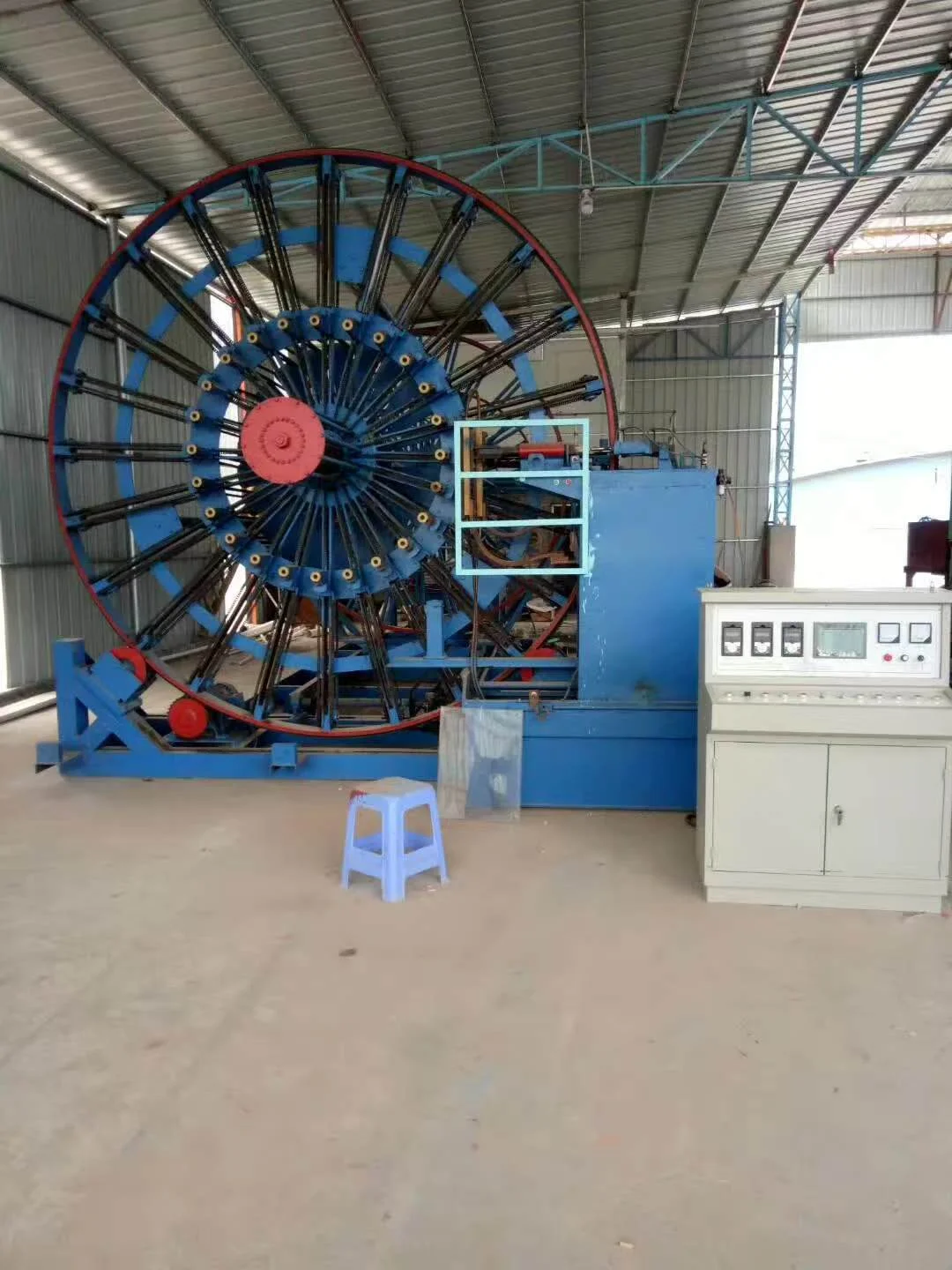
Structural integrity under ASTM C76 D-load testing depends on the precision of the reinforcing cage. Learn how CNC roll welders automate cage fabrication, enforce pitch tolerances, and eliminate hand-tying inconsistencies.
1. Why Cage Precision Dictates Pipe Load Capacity
In reinforced concrete drainage and sewer pipes, concrete excels in compression while steel reinforcement carries critical tensile stresses induced by backfill soil loads and heavy vehicular traffic. A misaligned cage, uneven helical pitch, or defective weld joints directly compromise the 0.3 mm crack test and ultimate crush resistance defined by ASTM C76 and GB/T 11836.
Manual cage tying is slow, labor-intensive, and inherently prone to spiral pitch irregularities. Modern precast pipe factories universally adopt CNC automatic steel cage welding machines to secure millimeter-level accuracy and robust structural integrity.
2. Automatic Resistance Roll Welding Mechanics
The CNC cage welder feeds cold-rolled ribbed rebar or hot-rolled wire from a decoiler. As the main drive faceplate rotates, the longitudinal bars are held securely in adjustable radial chucks. A traveling carriage advances synchronously, winding the circumferential spiral wire around the longitudinal bars.
At every intersection, an automatic pneumatic welding electrode applies focused pressure and delivers an instantaneous medium-frequency resistance pulse. The steel heats to forging temperature without melting through, creating a solid metallurgical bond.
3. Allowable Dimensional & Pitch Tolerances
| Inspection Parameter | Industrial Standard Tolerance | Factory Quality Control Target |
|---|---|---|
| Cage Inner Diameter (ID) | +5 / -0 mm | +3 / -0 mm |
| Cage Outer Diameter (OD) | 卤5 mm | 卤3 mm |
| Overall Cage Length | +5 / -10 mm | 卤5 mm |
| Helical Spiral Pitch Error | 卤5 mm over 10 consecutive wraps | 卤3 mm continuous |
| Longitudinal Bar Spacing | Max variance 鈮?40 mm | Max variance 鈮?20 mm |
| Longitudinal End Projection | Max 15鈥?0 mm beyond spiral wire | Max 10 mm cleanly trimmed |
| Weld Cross-Section Loss | Maximum 10% reduction | Kept under 5% via current modulation |
4. Bell and Spigot End-Ring Densification
The ends of reinforced concrete pipes endure intense shear stresses during installation and handling. Under industrial manufacturing rules, the automatic welding program must execute 'dense double-loop wraps' (瀵嗙剨鍙岀幆):
鈥?Both the socket/bell end and spigot end must be wrapped with at least two complete 360-degree closed circular loops with zero pitch spacing.
鈥?Diagonal cross-brace ties (鏂滄媺绛? are welded across the leading edge to prevent cage deformation when hoisted by forklift or gantry crane.
5. Placement of Rebar Spacers & Concrete Cover
Without adequate concrete cover depth, reinforcing steel is susceptible to groundwater chloride corrosion and carbonation. Precision-formed steel or polymer spacer clips must be attached around the cage periphery:
鈥?Layer-to-layer clips (灞傞棿鍗″瓙) maintain uniform concentric spacing in double-cage pipes (inner cage and outer cage) with height tolerance 卤2 mm.
鈥?Cover depth clips (淇濇姢灞傚崱瀛? must bear firmly against the internal surface of the steel mold, guaranteeing a minimum concrete cover of 20鈥?5 mm.
6. Tensile & Weld Joint Testing Protocols
Destructive weld testing is conducted on test specimens every production shift:
1. Cross-Weld Tensile Test: The welded joint must exhibit a tensile strength failure in the parent metal, not in the weld nugget itself. The ultimate tensile strength reduction must not exceed 20%.
2. Repeated Bend Test: Rebar wires undergo 90-degree reverse bend testing (GB/T 238) to confirm zero micro-fracturing along the heated zone.
Planning a Concrete Pipe Manufacturing Project?
Our engineering team provides comprehensive turnkey plant calculations, foundation layout drawings, mold customization specifications, and commercial quotations within 2 hours.
Related Technical Articles
Modular Precast Concrete Manhole & Inspection Well Manufacturing: ASTM C478 Specification & Monolithic Base Casting
Precast manholes and inspection chambers must withstand deep earth loads and prevent groundwater infiltration. Learn mold configurations for base sections, risers, and eccentric transition cones complying with ASTM C478.
Trenchless Jacking Pipe Manufacturing: High-Thrust Tolerance, Integrated Steel Collar Molds & DIN EN 1916 Standards
Trenchless microtunneling eliminates surface disruption but subjects concrete pipes to extreme jacking thrusts. Master high-strength concrete proportioning, steel collar mold fabrication, and DIN EN 1916 / ASTM C76 compliance.
Suspension Roller Concrete Pipe Production Process: Complete Step-by-Step Industrial Guide
Suspension roller pipe making machines are the global workhorse for producing high-density reinforced concrete pipes (DN300–DN2000). This comprehensive factory guide covers the end-to-end production workflow, from aggregate grading and CNC cage welding to dual-speed roller compaction and 4-stage steam curing.