Fabrication de Tuyaux de Fonçage sans Tranchée : Résistance Forte Poussée, Virole Acier et Norme concrete pipe and fittings specification
Ingénierie de tuyaux de microtunnelier résistant à 1500+ kN de poussée axiale, garnitures à lèvres triples et contrôle laser.
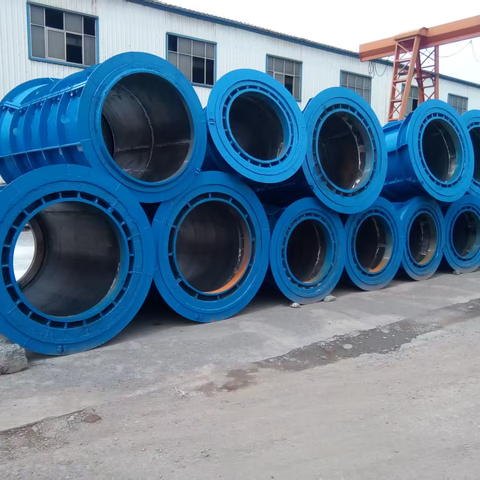
Le microtunnelier sans tranchée préserve la surface mais impose aux tuyaux de violentes poussées hydrauliques. Maîtrisez les bétons haute performance, les moules pour viroles en acier et la conformité à la norme concrete pipe and fittings specification.
1. The Demanding Physics of Trenchless Pipe Jacking
In modern urban infrastructure, open-cut trench excavation is frequently impossible due to existing highway pavements, building foundations, water bodies, and subterranean metro tunnels. Trenchless pipe jacking (顶管 / 顶进施工) propels a cutting shield head underground, with high-capacity hydraulic jacking rams in the drive shaft pushing the string of reinforced concrete pipes forward through the soil.
During driving, each pipe section acts as a structural column transmitting immense axial thrust forces–攐ften ranging from 1,500 kN on DN800 pipes to over 12,000 kN on DN2400/DN3000 pipes. Any minute irregularity in end-face squareness will concentrate thrust into point contact, causing catastrophic explosive spalling underground.
2. Jacking Joint Profiles: Steel Collar (F-Type) vs. In-Wall (J-Type)
Two joint architectures dominate international trenchless engineering:
1. Steel Collar Joint (F-Type / 钢套环接头: A roll-formed heavy-duty structural steel carbon or stainless steel sleeve (thickness 10• 6 mm) is cast directly into the spigot end of the pipe. When jacked together, the steel sleeve slides over the adjacent pipe's rebated shoulder, encasing a wedge-shaped elastomeric profile gasket. Offers superior angular deflection tolerance (up to 1.0掳• .5掳) without leaking.
2. In-Wall Rebated Joint (J-Type / 闃舵鎵挎彃鎺ュご): Fully concrete stepped joint with internal rubber gasket groove. Eliminates external steel collars, highly popular in non-aggressive soil environments.
3. Precision End-Ring Tolerances & Lathe Machining
Standard drainage pipe molds allow end squareness deviations of ±3 mm to ±5 mm. For jacking pipes, this would cause disastrous point loading under hydraulic ram forces.
| Dimensional Characteristic | concrete pipe and fittings specification / heavy-duty concrete pipe Jacking Standard | HLY Precision Mold Guarantee |
|---|---|---|
| End Face Perpendicularity | ≤ 1.0 mm deviation across full diameter | ≤ 0.5 mm turned on 8-meter CNC lathe |
| End Face Planarity (Flatness) | ≤ 0.8 mm surface waviness | ≤ 0.3 mm precision ground |
| Pipe Barrel Straightness | ≤ 2.0 mm per meter length (max 4.0 mm) | ≤ 1.0 mm per meter laser verified |
| Steel Collar Recess Fit | Tight tolerance ±0.5 mm | Interlocking locator pins hold ±0.3 mm |
| Wall Thickness Uniformity | ±3 mm around circumference | ±1.5 mm concentric CNC machined rings |
4. Calculating & Resisting Extreme Axial Thrust Loads
Jacking pipe design must resist permissible jacking force (F_j) calculated per pipeline engineering calculation / ATV-A 161 standards:
F_j ≤ A_c × f_cd × k_1 × k_2
Where A_c is the concrete cross-sectional area, f_cd is the design compressive strength, k_1 accounts for cushion ring stress distribution (0.65• .80), and k_2 accounts for angular deflection during curved driving.
HLY jacking pipe molds ensure the full annular bearing area is 100% planar, maximizing usable thrust capacity without local failure.
5. The Critical Role of Wooden Cushion Packing Rings
Between the concrete pipe faces, a wooden packing cushion ring (木垫圈 made from multi-layer marine plywood, chipboard, or fiberboard of 12• 8 mm thickness) must be installed. The wooden cushion crushes under early jacking pressure, redistributing uneven stress peaks across the full circumference.
6. High-Performance Concrete Mix: C50/C60 with Silica Fume
Jacking pipes require heavy-duty high-performance concrete (HPC):
• Compressive Strength: Minimum C50 or C60 (50• 0 MPa at 28 days; ≤ 5 MPa before demolding).
• Silica Fume / Slag Additions: 5% to 8% condensed silica fume (微硅粉 added to refine pore structures, increasing surface abrasion resistance and chemical impermeability against underground slurry.
• Low Water-Binder Ratio: Maintained between 0.30 and 0.34 with high-range polycarboxylate superplasticizers.
7. Frequently Asked Engineering Questions
Articles Techniques Associés
Soudage de Cages d'Armature pour Tuyaux en Béton : Fabrication CNC et Norme heavy-duty concrete pipe
La résistance à l'écrasement heavy-duty concrete pipe dépend de la précision de la cage d'armature. Découvrez comment les soudeuses CNC automatisent la confection des cages et suppriment les défauts du ligaturage manuel.
Fabrication de Regards de Visite en Béton Préfabriqué : Norme precast manhole et Éléments de Fond Monolithiques
Les regards de visite préfabriqués doivent résister aux charges de remblai et garantir une étanchéité absolue. Présentation des moules pour éléments de fond, rehausses et cônes conformes à la norme precast manhole.
Processus de Fabrication de Tuyaux en Béton à Rouleau Suspendu : Guide Industriel Complet
Les machines à rouleau suspendu sont la référence mondiale pour fabriquer des tuyaux en béton armé haute densité (DN300–DN2000). Ce guide couvre l'intégralité du flux de production, du dosage des agrégats au compactage centrifuge et à l'étuvage thermique en 4 phases.