Guia de Produção de Fossas Sépticas de Concreto Pré-Moldado: Formas de Aço e Normas EN 12566
Projeto de formas para fossas sépticas residenciais e industriais: vedação estanque e nervuras contra empuxo freático.
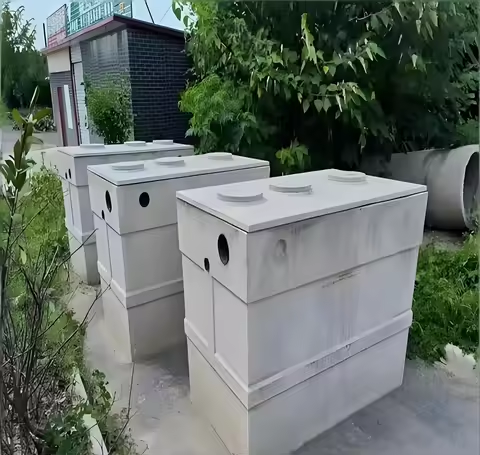
Fossas sépticas pré-moldadas demandam estanqueidade absoluta e resistência mecânica. Este guia revisa a fabricação de formas de aço multicâmaras, septos divisórios internos e ensaios de estanqueidade.
1. Environmental Mandates for Precast Concrete Septic Tanks
In rural sanitation upgrades, commercial development, and residential decentralization, precast reinforced concrete septic tanks (水泥化粪池) outperform plastic (rotomolded polyethylene) tanks by delivering superior structural stiffness, zero risk of crush failure under heavy backfill or traffic loads, and complete resistance to groundwater uplift.
Environmental regulatory bodies enforce zero-leakage mandates to safeguard subsurface aquifers from pathogenic sewage contamination. Achieving certified watertightness requires factory-engineered steel molds with rigid tolerance control.
2. Standard Capacities & Multi-Chamber Hydraulic Design
HLY supplies modular steel septic tank formwork systems covering capacities from 2,000 Liters up to 20,000 Liters (2.0 m³ to 20.0 m³):
| Tank Model | Liquid Capacity | Dimensions (L × W × H) | Chamber Partition | Target Application |
|---|---|---|---|---|
| HLY-ST5 | 5,000 Liters (5 m³) | 2,800 × 1,600 × 1,800 mm | 2 Chambers (2:1 Ratio) | Single-family residential / small villas |
| HLY-ST10 | 10,000 Liters (10 m³) | 3,800 × 2,000 × 2,000 mm | 3 Chambers (Baffled) | Multi-family clusters & commercial clinics |
| HLY-ST15 | 15,000 Liters (15 m³) | 4,800 × 2,200 × 2,200 mm | 3 Chambers + Bio-filter | Rural school campuses & service stations |
| HLY-ST20 | 20,000 Liters (20 m³) | 5,800 × 2,400 × 2,400 mm | Modular Segmental | Resort hotels, factories & industrial camps |
3. Mold Architectures: Two-Piece Split vs. Monolithic Vertical
Precast factories select between two proven mold architectures depending on lifting capacities:
1. Two-Piece Mid-Seam Mold (上下分体式模具): Casts a bottom tub and top lid with a tongue-and-groove horizontal midline seam. Lighter individual lifts make it suitable for smaller gantry cranes (5T–10T). The seam is hermetically sealed during installation using continuous butyl mastic sealant.
2. Monolithic Single-Pour Mold (整体浇筑立式模具): Casts the entire tank body and bottom slab in a single seamless pour using a hydraulically collapsing inner core. Delivers 100% leak-proof security below the water line.
4. ASTM C1227 & EN 12566-1 Testing Standards
Precast septic tanks exported globally must verify structural integrity and watertightness:
• Hydrostatic Water Exfiltration Test: Filled with water to top of riser for 24 hours. Water drop must not exceed 1% over subsequent 1-hour test.
• Vacuum Acceptance Test (ASTM C1227): Tank is sealed and subjected to a vacuum of 100 mm (4 in.) of mercury. Pressure must hold without dropping by more than 10% in 5 minutes.
• Structural Proof Loading: Top slab designed to resist AASHTO H-20 wheel loading (16,000 lbs wheel load) or pedestrian soil cover loading without distress.
5. Structural Reinforcement & Anti-Buoyancy Design
In high groundwater tables, an empty septic tank behaves like a concrete ship, susceptible to buoyancy flotation. HLY molds incorporate cast-in anti-buoyancy exterior flanges (防浮底翼缘) around the base slab perimeter, allowing backfill soil weight to permanently anchor the tank.
Reinforcement rebar cages are pre-assembled using deformed high-yield rebar (Grade 60 / HRB400) welded in dual orthogonal grids to resist earth pressure bending moments.
6. Shopfloor Casting, Core Stripping & Sealing Assembly
With Self-Consolidating Concrete (SCC), casting is completed in under 20 minutes without manual honeycombing defects. External pneumatic vibrators mounted along the stiffeners guarantee dense compaction around pipe penetrations.
HLY quick-release mechanical eccentric locks allow operators to strip outer forms in 15 minutes, while the collapsible inner core retracts cleanly without chipping internal corners.
7. Frequently Asked Engineering Questions
Planning a Concrete Pipe Manufacturing Project?
Our engineering team provides comprehensive turnkey plant calculations, foundation layout drawings, mold customization specifications, and commercial quotations within 2 hours.
Artigos Técnicos Relacionados
Processo de Fabricação de Tubos de Concreto por Rolo de Suspensão: Guia Industrial Completo
As máquinas de rolo de suspensão são o padrão global para produção de tubos de concreto armado de alta densidade (DN300–DN2000). Este guia abrange todo o fluxo produtivo, da dosagem de agregados e solda CNC de armaduras até a compactação por rolo e a cura térmica em 4 estágios.
Fabricação de Galerias Celulares de Concreto (Box Culvert): Formas Modulares e Normas ASTM C1433
Galerias celulares pré-moldadas são a escolha ideal para drenagem pluvial e passagens inferiores. Conheça o projeto de formas modulares de aço, sistemas hidráulicos de desforma e armações conformes à ASTM C1433.
Rolo de Suspensão vs. Vibração com Núcleo Ascendente: Qual Máquina se Adapta à sua Fábrica?
A escolha entre compactação por rolo de suspensão e vibração de núcleo ascendente define o investimento em formas e o volume de tubos por turno. Analisamos dinâmica de compactação, mão de obra e retorno do investimento.