Fabricação de Tubos de Cravação sem Vala (Jacking): Alta Resistência a Empuxo, Colar de Aço e Normas DIN EN 1916
Engenharia de tubos para microtúnel com resistência axial de 1500+ kN, vedações labiais triplas e controle de perpendicularidade a laser.
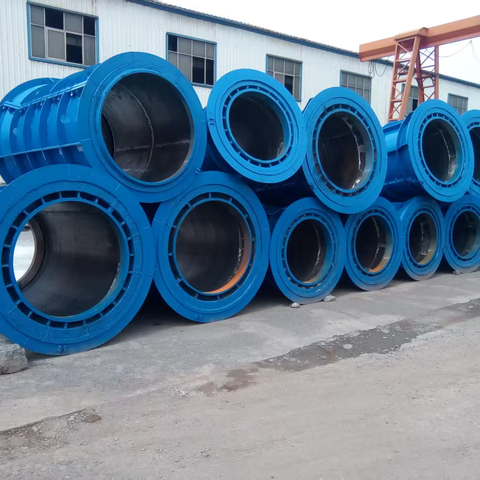
A cravação por microtúnel sem vala evita intervenções na superfície, mas submete os tubos de concreto a enormes forças de empuxo. Domine o traço de concreto de alta resistência, formas com colar de aço e a norma DIN EN 1916.
1. The Demanding Physics of Trenchless Pipe Jacking
In modern urban infrastructure, open-cut trench excavation is frequently impossible due to existing highway pavements, building foundations, water bodies, and subterranean metro tunnels. Trenchless pipe jacking (寰《绠?/ 椤惰繘鏂藉伐) propels a cutting shield head underground, with high-capacity hydraulic jacking rams in the drive shaft pushing the string of reinforced concrete pipes forward through the soil.
During driving, each pipe section acts as a structural column transmitting immense axial thrust forces鈥攐ften ranging from 1,500 kN on DN800 pipes to over 12,000 kN on DN2400/DN3000 pipes. Any minute irregularity in end-face squareness will concentrate thrust into point contact, causing catastrophic explosive spalling underground.
2. Jacking Joint Profiles: Steel Collar (F-Type) vs. In-Wall (J-Type)
Two joint architectures dominate international trenchless engineering:
1. Steel Collar Joint (F-Type / 閽㈠鐜帴澶?: A roll-formed Q345B carbon or stainless steel sleeve (thickness 10鈥?6 mm) is cast directly into the spigot end of the pipe. When jacked together, the steel sleeve slides over the adjacent pipe's rebated shoulder, encasing a wedge-shaped elastomeric profile gasket. Offers superior angular deflection tolerance (up to 1.0掳鈥?.5掳) without leaking.
2. In-Wall Rebated Joint (J-Type / 闃舵鎵挎彃鎺ュご): Fully concrete stepped joint with internal rubber gasket groove. Eliminates external steel collars, highly popular in non-aggressive soil environments.
3. Precision End-Ring Tolerances & Lathe Machining
Standard drainage pipe molds allow end squareness deviations of 卤3 mm to 卤5 mm. For jacking pipes, this would cause disastrous point loading under hydraulic ram forces.
| Dimensional Characteristic | DIN EN 1916 / ASTM C76 Jacking Standard | HLY Precision Mold Guarantee |
|---|---|---|
| End Face Perpendicularity | 鈮?1.0 mm deviation across full diameter | 鈮?0.5 mm turned on 8-meter CNC lathe |
| End Face Planarity (Flatness) | 鈮?0.8 mm surface waviness | 鈮?0.3 mm precision ground |
| Pipe Barrel Straightness | 鈮?2.0 mm per meter length (max 4.0 mm) | 鈮?1.0 mm per meter laser verified |
| Steel Collar Recess Fit | Tight tolerance 卤0.5 mm | Interlocking locator pins hold 卤0.3 mm |
| Wall Thickness Uniformity | 卤3 mm around circumference | 卤1.5 mm concentric CNC machined rings |
4. Calculating & Resisting Extreme Axial Thrust Loads
Jacking pipe design must resist permissible jacking force (F_j) calculated per DIN 1610 / ATV-A 161 standards:
F_j 鈮?A_c 脳 f_cd 脳 k_1 脳 k_2
Where A_c is the concrete cross-sectional area, f_cd is the design compressive strength, k_1 accounts for cushion ring stress distribution (0.65鈥?.80), and k_2 accounts for angular deflection during curved driving.
HLY jacking pipe molds ensure the full annular bearing area is 100% planar, maximizing usable thrust capacity without local failure.
5. The Critical Role of Wooden Cushion Packing Rings
Between the concrete pipe faces, a wooden packing cushion ring (鏈ㄥ灚鍦? made from multi-layer marine plywood, chipboard, or fiberboard of 12鈥?8 mm thickness) must be installed. The wooden cushion crushes under early jacking pressure, redistributing uneven stress peaks across the full circumference.
6. High-Performance Concrete Mix: C50/C60 with Silica Fume
Jacking pipes require heavy-duty high-performance concrete (HPC):
鈥?Compressive Strength: Minimum C50 or C60 (50鈥?0 MPa at 28 days; 鈮?5 MPa before demolding).
鈥?Silica Fume / Slag Additions: 5% to 8% condensed silica fume (寰绮? added to refine pore structures, increasing surface abrasion resistance and chemical impermeability against underground slurry.
鈥?Low Water-Binder Ratio: Maintained between 0.30 and 0.34 with high-range polycarboxylate superplasticizers.
7. Frequently Asked Engineering Questions
Planning a Concrete Pipe Manufacturing Project?
Our engineering team provides comprehensive turnkey plant calculations, foundation layout drawings, mold customization specifications, and commercial quotations within 2 hours.
Artigos Técnicos Relacionados
Soldagem de Gaiolas de Aço para Tubos de Concreto: Fabricação CNC e Normas ASTM C76
A resistência estrutural em ensaios de compressão diametral ASTM C76 depende da precisão da armadura. Saiba como soldadoras CNC automatizam a produção de gaiolas e eliminam imperfeições da amarração manual.
Fabricação de Poços de Visita de Concreto Pré-Moldado: Norma ASTM C478 e Bases Monolíticas
Poços de visita pré-moldados devem suportar sobrecargas de aterro e impedir infiltração de água subterrânea. Conheça as configurações de formas para bases, anéis e cones de transição conforme ASTM C478.
Processo de Fabricação de Tubos de Concreto por Rolo de Suspensão: Guia Industrial Completo
As máquinas de rolo de suspensão são o padrão global para produção de tubos de concreto armado de alta densidade (DN300–DN2000). Este guia abrange todo o fluxo produtivo, da dosagem de agregados e solda CNC de armaduras até a compactação por rolo e a cura térmica em 4 estágios.