Moldagem de Canaletas em U e Valas de Drenagem de Concreto: Guia de Formas de Aço
Fabricação de canais de irrigação agrícola, valas ferroviárias e drenagem municipal com ângulos de desmolde precisos.
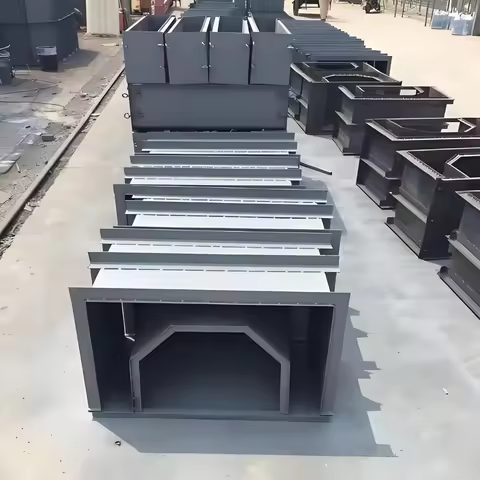
Canaletas em U exigem ângulos de saída rigorosos e superfícies lisas para o escoamento hidráulico. Este guia técnico detalha o projeto de formas de aço, mesas vibratórias e produção em série.
1. The Crucial Role of Precast U-Channels in Modern Infrastructure
From high-speed railway embankments and highway medians to urban stormwater gutters and agricultural water-saving irrigation networks, precast concrete U-channels (U型槽 / 排水沟) provide superior hydraulic conveyance efficiency compared to unlined earthen ditches or cast-in-place gutters.
Precasting U-channels in factory conditions ensures high compressive strength (C30/C35), low permeability, and glass-smooth hydraulic inverts with a low Manning roughness coefficient (n = 0.012–0.013), minimizing sediment buildup and water delivery losses.
2. Common U-Channel Cross-Sections & Dimensional Classes
HLY manufactures precision steel formwork for a broad spectrum of channel geometries:
- Municipal Drainage Gutters with Cast-Iron Grate Rebates: Standard widths 200–600 mm, depths 200–800 mm, featuring cast-in ductile iron or galvanized steel angle edge protection for traffic load bearing (EN 1433 Class C250 to F900).
- Agricultural Trapezoidal & Semi-Circular Irrigation Flumes: Top widths 600–2000 mm, lengths 2.0–4.0 m, designed for interlocking water-saving irrigation distribution networks.
- Deep Railway Cable & Utility Troughs: Multi-compartment U-channels with matching precast concrete cover slabs.
3. Modular Gang Mold Engineering & Draft Angle Design
Productivity in precast U-channel manufacturing depends upon maximizing output per casting cycle while avoiding surface damage during core withdrawal.
| Design Feature | Standard Fabrication Specification | Operational Advantage |
|---|---|---|
| Gang Mold Configuration | 4 to 8 channel bays per master frame | Multiplies output per crane hoist cycle |
| Demolding Draft Angle (拔模斜度) | 1.5° to 2.5° precision taper on inner core | Prevents surface shear tearing upon stripping |
| Steel Facing Material | 5 mm – 6 mm Q235B cold-rolled steel plate | Zero wave distortion, high wear resistance |
| Hinged Side Formwork | Quick-acting cam-lock levers and hinged wings | Tool-free opening in under 30 seconds |
| Interlocking Joint Profile | Stepped shiplap or tongue-and-groove ends | Ensures precise alignment and mastic sealing |
4. Vibration Consolidation: Table Vibrators vs. Core Poking
Manual poker vibration is inefficient and produces inconsistent concrete density along thin channel walls. HLY recommends two automated consolidation methods:
1. Synchronized High-Frequency Vibration Tables: The complete gang mold is clamped pneumatically to a heavy vibration table operating at 2,800–3,600 rpm. Vibration energy transmits through the entire steel mold, fluidizing low-slump concrete in 45–60 seconds.
2. Formwork-Mounted Pneumatic Vibrators: High-amplitude rotary ball or turbine vibrators mounted symmetrically on the mold frame deliver directional vibration directly to the vertical walls.
5. High-Durability Anti-Scour Concrete Mix Specifications
Because drainage channels and irrigation flumes face continuous water flow, abrasive suspended sand, and freeze-thaw cycles, the concrete mix must achieve:
• Minimum Compressive Strength: C30/C35 (30–35 MPa) at 28 days.
• Water-Cement Ratio: Kept low at 0.36 to 0.40 using polycarboxylate superplasticizers.
• Coarse Aggregate: Crushed basalt or granite (max size 10–15 mm, graded) to resist water scour.
• Air Content: 4.0% to 5.5% air entrainment for cold climates subject to winter de-icing salts.
6. Demolding Cycles, Grate Seating & Storage Yard Handling
With accelerated steam curing or radiant heat beds, U-channel gang molds complete 2 to 3 turnover cycles per 8-hour shift. Precast units are hoisted using specialized scissor clamps or lifting threaded sockets cast into the channel walls.
Channels are palletized horizontally with timber battens between tiers (maximum 5 tiers high), ready for immediate flatbed container loading.
7. Frequently Asked Engineering Questions
Planning a Concrete Pipe Manufacturing Project?
Our engineering team provides comprehensive turnkey plant calculations, foundation layout drawings, mold customization specifications, and commercial quotations within 2 hours.
Artigos Técnicos Relacionados
Rolo de Suspensão vs. Vibração com Núcleo Ascendente: Qual Máquina se Adapta à sua Fábrica?
A escolha entre compactação por rolo de suspensão e vibração de núcleo ascendente define o investimento em formas e o volume de tubos por turno. Analisamos dinâmica de compactação, mão de obra e retorno do investimento.
Misturadores de Concreto de Duplo Eixo para Fábricas de Tubos: Série JS para Concreto Seco
O concreto seco sem abatimento exige alta energia de cisalhamento para envolver os agregados com pasta de cimento. Saiba como misturadores de duplo eixo série JS controlam a umidade e aumentam a durabilidade das chapas de desgaste.
Processo de Fabricação de Tubos de Concreto por Rolo de Suspensão: Guia Industrial Completo
As máquinas de rolo de suspensão são o padrão global para produção de tubos de concreto armado de alta densidade (DN300–DN2000). Este guia abrange todo o fluxo produtivo, da dosagem de agregados e solda CNC de armaduras até a compactação por rolo e a cura térmica em 4 estágios.