Производство железобетонных труб радиальным прессованием: пошаговое руководство для заводов ЖБИ
Детальный технологический регламент: подбор инертных, сварка каркасов, режимы прессования и 4-стадийная термовлажностная обработка (ТВО).
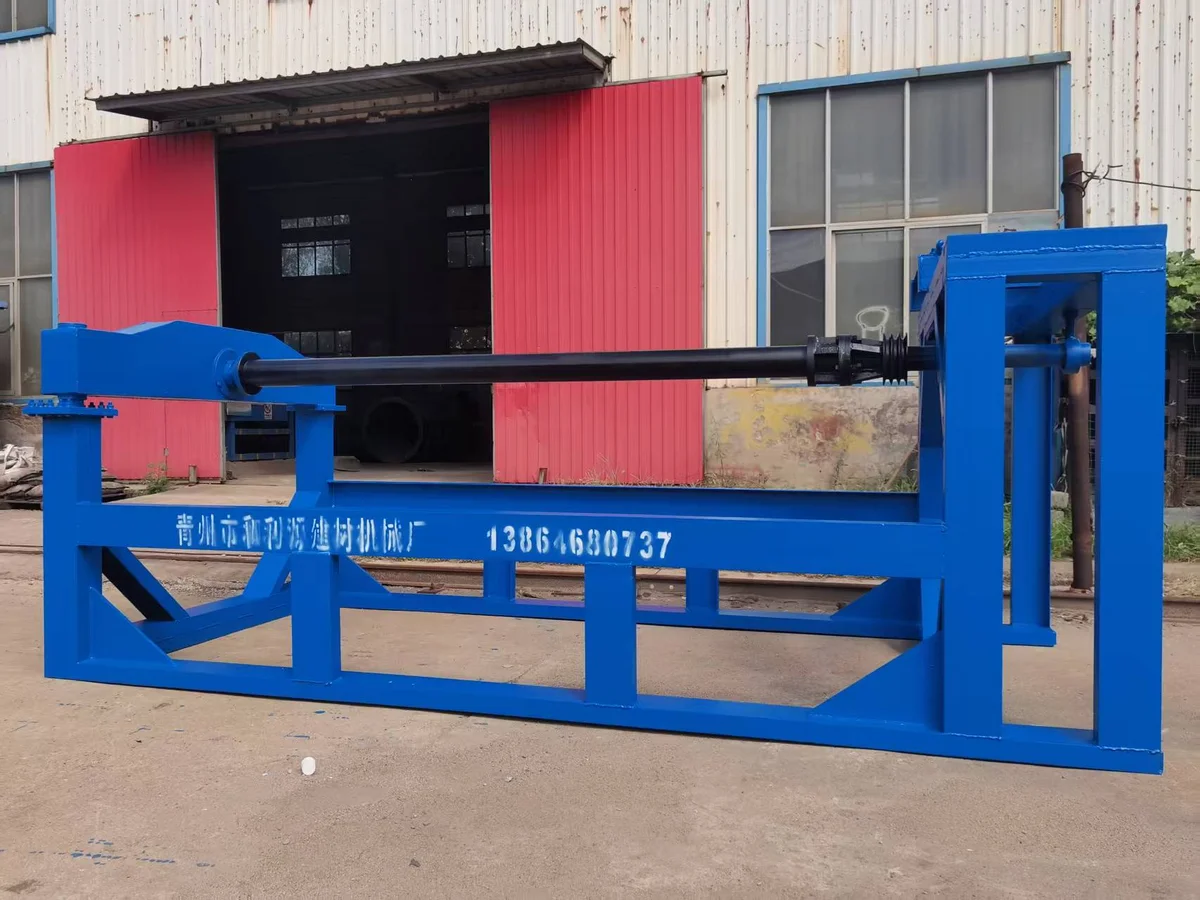
Станки радиального прессования — мировой стандарт для выпуска безнапорных железобетонных труб (DN300–DN2000). В руководстве подробно описан весь технологический цикл: от гранулометрии песка и щебня до двухскоростной прикатки и пропарки в ямных камерах.
1. Overview of Suspension Roller Technology
The suspension roller concrete pipe machine (also known as centrifugal roller compaction) is one of the most reliable, cost-effective technologies for manufacturing reinforced concrete drainage, culvert, and microtunneling pipes ranging from DN300 to DN2000 mm with standard lengths of 2000 mm, 2500 mm, 3000 mm, and 4000 mm.
During the forming cycle, the cylindrical steel pipe mold is suspended horizontally upon a driven heavy-duty roller shaft. As the mold rotates at controlled speeds, dry-cast low-slump concrete is distributed along the interior surface by a traveling feeder belt. The combination of high centrifugal force, intense mechanical rolling compression between the roller shaft and the mold, and vibrational kneading produces concrete densities exceeding 2,450 kg/m鲁 with exceptional structural impermeability.
Centrifugal force uniformly distributes the dry mix across the internal circumference, while the high line pressure of the hardened alloy roller shaft expels entrapped air and excess moisture, achieving immediate structural stability before de-molding.
2. Raw Material Standards & Aggregate Sizing Constraints
Producing high-grade ASTM C76 Class III鈥揤 or GB/T 11836 standard pipes requires strict adherence to raw material parameters. Inferior aggregate grading or unverified cement directly leads to internal delamination, honeycomb defects, or structural failure under Three-Edge Bearing load tests.
| Raw Material | Standard & Grade | Technical Requirements | Quality Control Check |
|---|---|---|---|
| Cement | Grade 32.5 / 42.5 Ordinary Portland Cement (OPC) or Slag Cement | Conforms to ASTM C150 / GB 175. Initial setting 鈮?5 min, final setting 鈮?2 hr. Soundness tested via Le Chatelier. | Sampled every 200 tons; verify manufacturer certificate. |
| Coarse Aggregate | Crushed Granite or Limestone (Cleaned) | For DN 鈮?1000mm: 5鈥?2mm crushed stone. For DN > 1000mm: 5鈥?0mm or 5鈥?5mm. Maximum size must not exceed 1/3 of pipe wall thickness and 3/4 of cage clear spacing. | Mud content 鈮?.0%; water-washed to remove silt and organic contaminants. |
| Fine Aggregate | Hard River Sand or Washed Manufactured Sand | Medium sand with fineness modulus (Mk) between 2.3 and 3.0. Zone II grading curve. | Mud content 鈮?.0%; screened to eliminate debris >5mm. |
| Water-Reducing Admixture | High-Range Polycarboxylate Superplasticizer (Non-Air-Entraining) | Must withstand accelerated steam curing without strength reversion. Increases early demolding strength by 30鈥?0%. | Lab compatibility testing with cement batch prior to dosing. |
| Water | Clean Deep Well or Municipal Potable Water | Free from sulfates, oils, acids, and alkalis. Complies with JGJ 63 / ASTM C1602. | Tested bi-annually for pH and total dissolved solids. |
3. Steel Reinforcement Cage Fabrication & Tolerances
The reinforcement cage provides the primary tensile strength required to resist earth overburden and hydrostatic pressure. Automated CNC steel cage welding machines are utilized to ensure uniform pitch and defect-free resistance spot welding.
According to industrial technical specifications, the fabrication procedure mandates the following critical control points:
- End Ring Densification: Both the spigot end and bell (socket) end must receive double closed welding loops (dense helical wraps) to prevent bell flare cracking during pipe handling and installation.
- Welding Resistance & Heat Control: Automatic resistance welding current and electrode wheel pressure must be calibrated so that steel wire cross-sectional reduction remains under 10%, and ultimate tensile strength drop remains under 20%.
- Cage Diameter & Length Tolerances: Inner diameter tolerance is kept within +5/-0 mm; outer diameter tolerance within 卤5 mm; overall cage length tolerance within +5/-10 mm.
- Spacing Clips & Cover Depth: Spacer clips (wheel or saddle type) made of galvanized steel or high-density plastic must be installed circumferentially every 1.0鈥?.2 m to guarantee concrete cover thickness (+8/-0 mm from inner/outer mold skin).
- Handling & Rigging: Cages must be hoisted using a rigid internal lifting beam (length 鈮?1/2 of cage length) to prevent structural sagging or distortion before entering the mold.
4. Dry-Cast Concrete Proportioning & Consistency
Suspension roller pipes require dry-cast (zero-slump) concrete. High-slump or excessively wet concrete will slide along the bottom of the mold rather than climbing and compacting against the roller shaft, leading to severe slurry separation and inner-surface washing.
The workability is measured via a Vebe Consistometer (缁村媰绋犲害浠?, with the target consistency maintained strictly at 20 to 30 seconds. On the factory floor, experienced operators verify the mix by hand: squeeze the fresh mix into a ball鈥攊t holds shape firmly without oozing water, and crumbles cleanly upon impact on the floor.
Batching Accuracy: Microcomputer-controlled batching scales must ensure automated weighing accuracy within 卤1% for cement, water, and admixtures, and within 卤3% for sand and stone aggregates. Total forced planetary mixing time must not be less than 3 minutes.
5. Mold Preparation & Release Agent Application
Pipe mold preparation directly governs pipe dimensional accuracy and exterior surface finish. The mold consists of two precision longitudinal half-shells, running drive rings (tyres), and end-forming rings.
- Mechanical De-scaling: Thoroughly scrape all hardened cement slurry from the mold skin, mating flanges, and joint tongues using pneumatic scrapers and wire brushes. Never use sledgehammers to strike the mold skin, as local denting causes out-of-round pipe profiles.
- Release Agent Chemistry: Use premium emulsified oil or mineral release oil. In summer, standard emulsion (emulsifier : water = 1:10) is applied; in winter, the solution is steam-heated to 40掳C to guarantee smooth atomized spray coverage without gummy residues.
- Gasket Sealing: Ensure the longitudinal flange sealing rubber strip is intact. Any mating gap exceeding 3 mm must be sealed to eliminate mortar bleeding during high-speed rolling.
- Cage Alignment: Place the cage inside the bottom half-mold, verify that all spacer clips rest firmly on the mold wall, and bolt both halves symmetrically with high-strength fasteners.
6. Mold Feeding & Dual-Speed Roller Compaction Parameters
Once the assembled mold is loaded onto the suspension roller machine and the hydraulic end-gate is locked in position, the forming operation proceeds in two distinct stages: Initial Feeding Speed and Net Compaction Speed.
| Pipe Diameter (DN) | Feeding Motor Speed (rpm) | Net Compaction Speed (rpm) | Net Rolling Duration (min) |
|---|---|---|---|
| DN300 鈥?DN450 mm | 400 鈥?450 rpm | 800 鈥?1000 rpm | 3.0 鈥?4.0 min |
| DN500 鈥?DN800 mm | 500 鈥?650 rpm | 900 鈥?1150 rpm | 4.0 鈥?5.5 min |
| DN900 鈥?DN1200 mm | 600 鈥?750 rpm | 950 鈥?1250 rpm | 5.0 鈥?6.5 min |
| DN1350 鈥?DN2000 mm | 650 鈥?800 rpm | 1000 鈥?1400 rpm | 6.0 鈥?8.0 min |
Standard Feeding Sequence:
1. Stage 1 (Stabilization): Spread concrete evenly across the full pipe barrel to 2/3 of the wall thickness. This anchors the steel cage and prevents centrifugal displacement.
2. Stage 2 (Joint Compaction): Feed material 250鈥?00 mm backward toward the spigot ring, then 250鈥?00 mm forward into the bell/socket ring until both end profiles reach ring height.
3. Stage 3 (Full Continuous Pass): Feed continuously from bell to spigot, allowing material to rise 3鈥? mm above the end ring profile to supply sufficient volume for final roller compaction.
4. Stage 4 (Net Roller Pass): Retract the feed conveyor and ramp up motor speed to Net Compaction Speed. Maintain continuous line-pressure rolling. If the surface is overly dry, apply a light, atomized water mist. Before stopping, lightly cast a 1:2 dry cement-sand mix onto the inner bore to smooth roller marks and prevent mortar adhering to the shaft.
7. 4-Stage Accelerated Steam Curing Protocol
To achieve high mold turnaround without compromising ultimate concrete matrix strength, precast concrete pipe facilities enforce a rigorous 4-stage steam curing protocol inside insulated curing pits or tunnels.
- Stage 1: Preset Delay Period (闈欏仠闃舵) 鈥?1.5 to 2.5 hours. The newly cast pipe is parked in the steam chamber with steam valves fully closed. This allows initial hydration to build early gel strength capable of resisting internal steam vapor pressure.
- Stage 2: Controlled Temperature Rise (鍗囨俯闃舵) 鈥?Heating rate must be strictly controlled at 鈮?0掳C per hour. Rapid heating creates thermal differentials between the steel mold and fresh concrete, inducing micro-cracks and surface crazing.
- Stage 3: Constant Temperature Soaking (鎭掓俯闃舵) 鈥?Maintain steam temperature at 65掳C to 75掳C (fluctuation within 卤5掳C) with relative humidity 鈮?5%. Duration is typically 3.5 to 5.0 hours depending on pipe wall thickness.
- Stage 4: Controlled Cooling (闄嶆俯闃舵) 鈥?Shut off steam and allow 1.5 to 2.0 hours of gradual cooling. The temperature differential between the pipe surface and ambient plant temperature must not exceed 40掳C in summer or 30掳C in winter to prevent thermal shock fractures.
8. Demolding, Dimensional Inspection & Load Testing
Demolding Quality Gate: Concrete compressive test cubes (100脳100脳100 mm) cured alongside the pipe batches must demonstrate compressive strength 鈮?0% of design strength (typically 鈮?4鈥?0 MPa) before de-molding is authorized.
Inspection Checklist:
鈥?Visual: Inner bore must be smooth and dense, free from honeycombs, exposed rebars, spalling, or circular crazing cracks.
鈥?Dimensional: Wall thickness verified with ultrasonic thickness gauges or calipers (tolerance +4/-2 mm); internal diameter checked across 4 orthogonal axes (tolerance 卤4 mm).
鈥?Three-Edge Bearing Test (TEBT): Carried out in accordance with ASTM C497 / GB/T 16752 to verify 0.3 mm crack load and ultimate collapse load rating.
鈥?Hydrostatic Pressure Test: Subjected to 0.10鈥?.15 MPa internal water pressure for 10 minutes with zero sweating or leakage along the barrel and bell joint.
9. Frequently Asked Engineering Questions
Planning a Concrete Pipe Manufacturing Project?
Our engineering team provides comprehensive turnkey plant calculations, foundation layout drawings, mold customization specifications, and commercial quotations within 2 hours.
Связанные технические руководства
Производство железобетонных коробчатых труб (Box Culvert): модульная опалубка и нормы ASTM C1433 / ГОСТ
Сборные коробчатые водопропускные трубы незаменимы в дорожном строительстве. Руководство по расчету стальной модульной опалубки, гидравлическим механизмам распалубки и схемам армирования по стандарту ASTM C1433.
Производство железобетонных септиков и локальных очистных сооружений: стальные пресс-формы и герметичность
Сборные железобетонные септики требуют полной водонепроницаемости и устойчивости к пучению грунта. Руководство по проектированию стальных форм, установке перегородок и гидростатическим испытаниям.
Радиальное прессование или виброформование с сердечником: выбор оборудования для завода ЖБИ
Выбор между роликовым радиальным прессованием и вертикальным виброформованием с выдвижным сердечником определяет бюджет оснастки и сменный выпуск труб. Анализируем динамику уплотнения, штат рабочих и окупаемость.