Sản Xuất Cống Hộp Bê Tông Đúc Sẵn: Thiết Kế Ván Khuôn Modular, Rút Lõi Thủy Lực & Tiêu Chuẩn ASTM C1433
Kỹ thuật chế tạo cống hộp liền khối và hào kỹ thuật nhiều ngăn với cơ cấu co rút lõi thủy lực và cốp pha ngoài vững chắc.
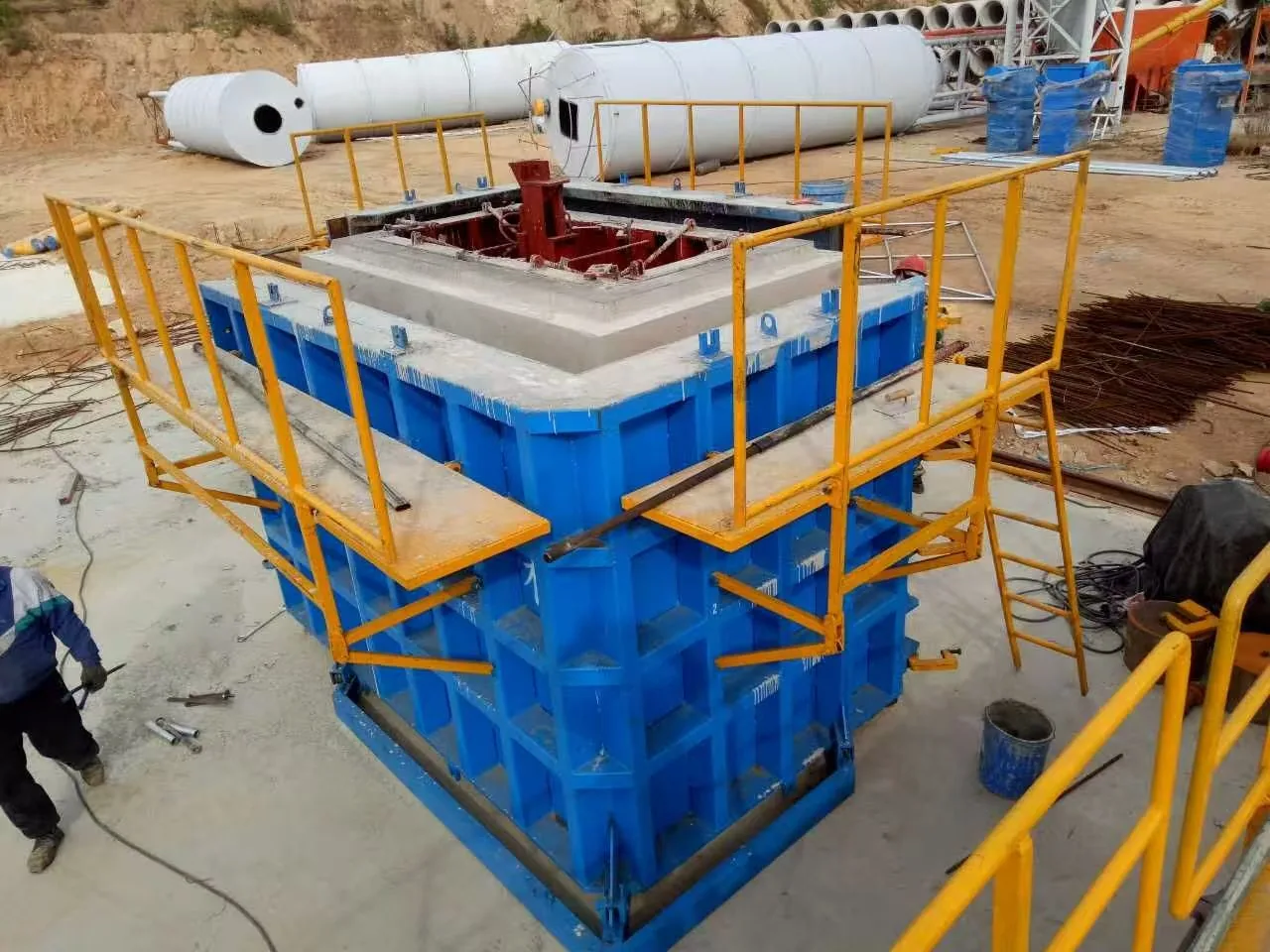
Cống hộp bê tông đúc sẵn là giải pháp hàng đầu cho thoát nước mưa và cống chui đường bộ. Khám phá thiết kế cốp pha thép module lắp ghép, cơ cấu tháo dỡ lõi thủy lực và quy chuẩn cốt thép theo tiêu chuẩn ASTM C1433 / TCVN.
1. The Rising Demand for Precast Box Culverts
In modern civil infrastructure, precast reinforced concrete box culverts have largely replaced traditional cast-in-place culverts due to superior quality control, rapid highway installation, and zero curing delays on project sites. Box culverts are deployed across highway drainage, railway underpasses, pedestrian subways, stream crossings, and comprehensive underground utility galleries (综合管廊).
Fabricating dimensionally accurate box culverts spanning from 1200×1200 mm up to 4000×4000 mm requires heavy-duty steel formwork capable of resisting intense lateral hydrostatic pressures without flexing during vibration.
HLY manufactures modular box culvert molds ranging from spans of 1.2 m to 4.0 m and rises of 1.0 m to 3.5 m, with wall and slab thicknesses ranging from 150 mm to 350 mm depending on earth overburden and traffic loading criteria.
2. Modular Formwork Design & Hydraulic Core Collapse
The primary challenge in box culvert precasting is core stripping. As concrete cures, shrinkage binds the hardened rectangular box tightly against the inner steel core. Traditional non-collapsible cores require excessive draft angles and brute crane force, frequently damaging the green concrete corners.
HLY engineers overcome this with our proprietary 4-corner hydraulic collapsible inner core system:
- Hydraulic Corner Articulation: Four synchronized double-acting hydraulic cylinders retract the corner chamfer sections inward by 80–120 mm, allowing the core walls to collapse away smoothly from all four inner concrete surfaces.
- Q345B High-Tensile Steel Plates: Formwork faceplates are precision-machined from 6–8 mm Q345B hot-rolled steel plate, reinforced with heavy channel stiffeners spaced at 300 mm intervals to ensure deflection under full liquid head remains under L/1000.
- Modular Height & Span Extensions: Bolted insert panels allow operators to adjust the culvert span and rise in 200 mm or 500 mm increments using a single base mold system.
- Integrated High-Frequency Vibrators: External pneumatic or electric vibrators (3,000–3,600 rpm) are mounted directly to the stiffener ribs, providing uniform vibrational compaction without segregating aggregate.
3. ASTM C1433 & ASTM C1577 Structural Requirements
Precast box culverts exported to international markets can be customized to support standard designs such as ASTM C1433 (standard design with earth cover between 0.6 m and 3.0 m) or ASTM C1577 (LRFD design for HL-93 live loading).
| Design Parameter | ASTM C1433 / C1577 Requirement | HLY Mold Fabrication Standard |
|---|---|---|
| Internal Span & Rise Tolerance | ±1% or ±10 mm (whichever is less) | ±3.0 mm laser-calibrated |
| Wall & Slab Thickness | Min 95% of design thickness (-5%) | +5 mm / -2 mm precision tolerance |
| Length of Section | ±13 mm per section | ±5 mm overall length tolerance |
| End Squareness (Diagonal) | Difference ≤ 13 mm between diagonals | Difference ≤ 5 mm across 4000 mm span |
| Steel Facing Flatness | Max 3 mm offset over 3 m straightedge | Precision CNC planed to ≤ 1.5 mm |
| Concrete Compressive Strength | Min 35 MPa (5,000 psi) at 28 days | Mix formulated for 45–55 MPa ultimate |
4. Concrete Casting: Self-Consolidating (SCC) vs. Dry-Cast
Two distinct casting philosophies are used depending on plant setup:
1. Self-Consolidating Concrete (SCC / 泵送自密实混凝土): Slump flow of 650–750 mm. Concrete is pumped through bottom injection ports or poured into top openings. The mix flows effortlessly through complex reinforcement cages without external vibration, producing an architectural glass-smooth surface finish.
2. Zero-Slump Dry-Cast (干硬性振动成型): Concrete is compacted using intensive high-frequency core vibrators. Enables immediate stripping of outer jackets, allowing multiple box sections to be cast per day using a single base pallet.
5. Tongue-and-Groove Joint Profiles & Waterproofing
Underground storm culverts and utility galleries cannot tolerate water infiltration. HLY box culvert molds feature precision-machined end rings producing interlocking tongue-and-groove joints (企口接头) with recess grooves designed for flexible preformed rubber gaskets (ASTM C1677) or self-expanding bentonite waterstop strips.
A 30×30 mm corner haunch (internal fillet) is integrated into all four corners to distribute negative bending moments and facilitate laminar water flow.
6. Handling, Proof Load Testing & Quality Checklist
Precast box culverts are rigged using four recessed spherical lifting anchors cast symmetrically into the top slab. A spreader beam ensures lifting cables remain vertical, preventing bending moments on the side walls during yard transport.
Prior to dispatch, random sample units undergo three-edge bearing proof load testing or flat-jack load simulations to confirm zero through-cracking under design wheel loads (AASHTO HS-20 / HL-93).
7. Frequently Asked Engineering Questions
Planning a Concrete Pipe Manufacturing Project?
Our engineering team provides comprehensive turnkey plant calculations, foundation layout drawings, mold customization specifications, and commercial quotations within 2 hours.
Bài Viết Kỹ Thuật Liên Quan
Quy Trình Sản Xuất Cống Bê Tông Bằng Máy Trục Lăn Treo: Hướng Dẫn Kỹ Thuật Công Nghiệp Toàn Diện
Máy đúc cống trục lăn treo là thiết bị chủ lực trên thế giới để sản xuất cống bê tông cốt thép tỷ trọng cao (DN300–DN2000). Cẩm nang nhà máy này bao gồm quy trình khép kín từ cấp phối vật liệu đến ép lăn hai cấp tốc độ và hấp bảo dưỡng hơi nước.
Cẩm Nang Sản Xuất Bể Tự Hoại (Bể Phốt) Bê Tông Đúc Sẵn: Khuôn Thép Cỡ Lớn & Chuẩn Kín Nước EN 12566
Bể phốt bê tông đúc sẵn đòi hỏi tính kín nước tuyệt đối và khả năng chống lại áp lực nước ngầm. Hướng dẫn chi tiết thiết kế khuôn thép phân ngăn, vách ngăn chống lắng và quy trình kiểm thử độ kín nước.
Máy Trục Lăn Treo So Với Máy Rung Lõi Đứng: Đâu Là Dòng Máy Phù Hợp Nhất Với Nhà Máy Của Bạn?
Lựa chọn giữa máy đầm lăn ly tâm trục treo và máy rung lõi nâng đứng quyết định cơ cấu vốn khuôn và sản lượng cống mỗi ngày. Phân tích chi tiết động học đầm nén, nhu cầu nhân công và hiệu quả thu hồi vốn.