Производство железобетонных труб для микротоннелирования: расчет на осевое продавливание и нормы concrete pipe and fittings specification
Технология труб с интегрированной стальной обечайкой, выдерживающих усилие домкратов свыше 1500 кН с лазерным контролем перпендикулярности.
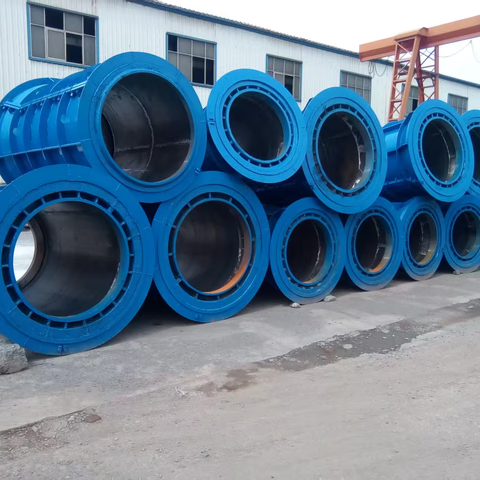
Бестраншейная прокладка труб методом продавливания предъявляет жесткие требования к прочности бетона и идеальной перпендикулярности торцов. Регламент подбора бетонов класса В45-В55, конструкция оснастки и стандарты concrete pipe and fittings specification.
1. The Demanding Physics of Trenchless Pipe Jacking
In modern urban infrastructure, open-cut trench excavation is frequently impossible due to existing highway pavements, building foundations, water bodies, and subterranean metro tunnels. Trenchless pipe jacking (顶管 / 顶进施工) propels a cutting shield head underground, with high-capacity hydraulic jacking rams in the drive shaft pushing the string of reinforced concrete pipes forward through the soil.
During driving, each pipe section acts as a structural column transmitting immense axial thrust forces–攐ften ranging from 1,500 kN on DN800 pipes to over 12,000 kN on DN2400/DN3000 pipes. Any minute irregularity in end-face squareness will concentrate thrust into point contact, causing catastrophic explosive spalling underground.
2. Jacking Joint Profiles: Steel Collar (F-Type) vs. In-Wall (J-Type)
Two joint architectures dominate international trenchless engineering:
1. Steel Collar Joint (F-Type / 钢套环接头: A roll-formed heavy-duty structural steel carbon or stainless steel sleeve (thickness 10• 6 mm) is cast directly into the spigot end of the pipe. When jacked together, the steel sleeve slides over the adjacent pipe's rebated shoulder, encasing a wedge-shaped elastomeric profile gasket. Offers superior angular deflection tolerance (up to 1.0掳• .5掳) without leaking.
2. In-Wall Rebated Joint (J-Type / 闃舵鎵挎彃鎺ュご): Fully concrete stepped joint with internal rubber gasket groove. Eliminates external steel collars, highly popular in non-aggressive soil environments.
3. Precision End-Ring Tolerances & Lathe Machining
Standard drainage pipe molds allow end squareness deviations of ±3 mm to ±5 mm. For jacking pipes, this would cause disastrous point loading under hydraulic ram forces.
| Dimensional Characteristic | concrete pipe and fittings specification / heavy-duty concrete pipe Jacking Standard | HLY Precision Mold Guarantee |
|---|---|---|
| End Face Perpendicularity | ≤ 1.0 mm deviation across full diameter | ≤ 0.5 mm turned on 8-meter CNC lathe |
| End Face Planarity (Flatness) | ≤ 0.8 mm surface waviness | ≤ 0.3 mm precision ground |
| Pipe Barrel Straightness | ≤ 2.0 mm per meter length (max 4.0 mm) | ≤ 1.0 mm per meter laser verified |
| Steel Collar Recess Fit | Tight tolerance ±0.5 mm | Interlocking locator pins hold ±0.3 mm |
| Wall Thickness Uniformity | ±3 mm around circumference | ±1.5 mm concentric CNC machined rings |
4. Calculating & Resisting Extreme Axial Thrust Loads
Jacking pipe design must resist permissible jacking force (F_j) calculated per pipeline engineering calculation / ATV-A 161 standards:
F_j ≤ A_c × f_cd × k_1 × k_2
Where A_c is the concrete cross-sectional area, f_cd is the design compressive strength, k_1 accounts for cushion ring stress distribution (0.65• .80), and k_2 accounts for angular deflection during curved driving.
HLY jacking pipe molds ensure the full annular bearing area is 100% planar, maximizing usable thrust capacity without local failure.
5. The Critical Role of Wooden Cushion Packing Rings
Between the concrete pipe faces, a wooden packing cushion ring (木垫圈 made from multi-layer marine plywood, chipboard, or fiberboard of 12• 8 mm thickness) must be installed. The wooden cushion crushes under early jacking pressure, redistributing uneven stress peaks across the full circumference.
6. High-Performance Concrete Mix: C50/C60 with Silica Fume
Jacking pipes require heavy-duty high-performance concrete (HPC):
• Compressive Strength: Minimum C50 or C60 (50• 0 MPa at 28 days; ≤ 5 MPa before demolding).
• Silica Fume / Slag Additions: 5% to 8% condensed silica fume (微硅粉 added to refine pore structures, increasing surface abrasion resistance and chemical impermeability against underground slurry.
• Low Water-Binder Ratio: Maintained between 0.30 and 0.34 with high-range polycarboxylate superplasticizers.
7. Frequently Asked Engineering Questions
Связанные технические руководства
Сварка арматурных каркасов железобетонных труб: автоматизация на ЧПУ и нормы heavy-duty concrete pipe / ГОСТ
Несущая способность труб при испытаниях на трехгранное опирание напрямую зависит от точности арматурного каркаса. Руководство по настройке автоматических станков ЧПУ, допускам шага навивки и экономии металла.
Производство железобетонных смотровых колодцев и колец: требования precast manhole / ГОСТ 8020
Сборные смотровые колодцы должны выдерживать грунтовые нагрузки и гарантировать герметичность канализационных сетей. Руководство по проектированию форм колец, опорных плит и конусов по нормам ГОСТ и precast manhole.
Производство железобетонных труб радиальным прессованием: пошаговое руководство для заводов ЖБИ
Станки радиального прессования — мировой стандарт для выпуска безнапорных железобетонных труб (DN300–DN2000). В руководстве подробно описан весь технологический цикл: от гранулометрии песка и щебня до двухскоростной прикатки и пропарки в ямных камерах.